

A lot can happen in 90 days.
You may have rebuilt trust, started sleeping better, laughed more, or felt something you hadn’t felt in a long time: hope.
Then the relapse happened.
For many alumni, a fentanyl relapse doesn’t just bring fear. It brings a crushing sense of disappointment. Not because they don’t understand addiction, but because they thought they were past this point.
At Freedom Recovery, we’ve had countless conversations with alumni who came back after a relapse and said some version of the same thing:
“I don’t know if I can face everyone again.”
The truth is that returning for help after a relapse is often one of the strongest decisions a person can make. If you’re questioning what comes next, our Drug Addiction Treatment services can help you understand your options and find your footing again.
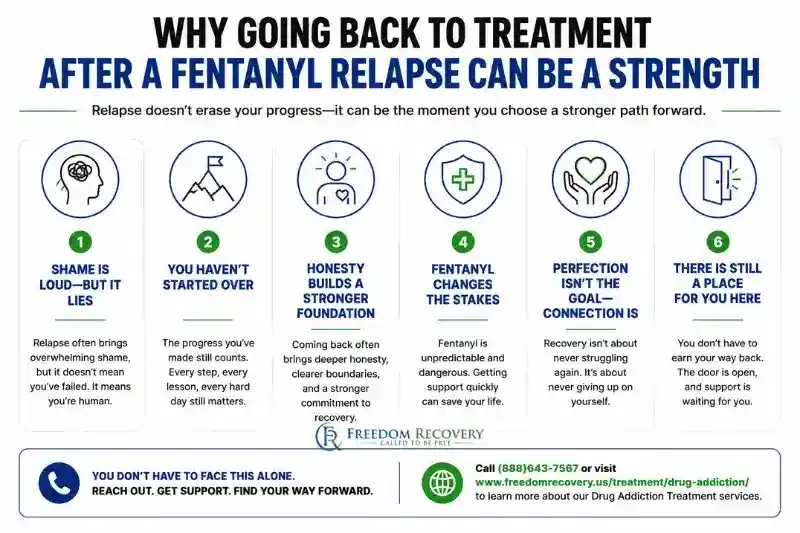
The Shame Usually Hurts More Than the Relapse
Fentanyl relapse can happen fast.
One difficult day becomes a difficult weekend. A single use becomes something bigger. Before long, shame starts talking louder than reality.
Shame says you failed.
Shame says you wasted everyone’s time.
Shame says you should have known better.
Recovery says something different.
Recovery says that what you do next matters more than what happened yesterday.
One of the hardest parts about relapse is that it can convince people to isolate right when they need support most. The longer someone stays alone with the story that they’ve ruined everything, the harder it becomes to ask for help.
Coming Back Doesn’t Mean Starting Over
This is something many people misunderstand.
A relapse does not erase the work you already did.
You still learned coping skills.
You still built relationships.
You still gained insight into your triggers, patterns, and warning signs.
Think of recovery like climbing a mountain in heavy fog. If you slip and fall, you don’t wake up back at sea level. You may lose ground, but the distance you’ve already traveled still matters.
When alumni return to treatment, they often come back with knowledge they didn’t have the first time. That experience can become one of their greatest strengths.
The People Who Return Often Have a Different Kind of Honesty
Something shifts after a relapse.
Many alumni stop trying to prove they can handle everything on their own.
The conversations become more real.
The willingness to ask for help arrives sooner.
The focus often moves away from appearing successful and toward staying alive, staying connected, and staying honest.
That honesty can create a stronger foundation than the one that existed before.
We’ve seen people come back feeling embarrassed and leave with a deeper commitment to recovery than they ever thought possible.
Fentanyl Changes the Stakes
Fentanyl has changed the recovery landscape.
Many people who previously experienced relapse episodes with other substances are discovering that fentanyl leaves much less room for error.
That’s one reason seeking help quickly matters.
Some alumni hesitate because they aren’t sure what level of care they need. They start researching questions, comparing options, and trying to determine what should come first. In those moments, conversations around detox vs rehab opioids often come up because people are trying to understand the safest path forward after returning to use.
The important thing is not having all the answers before reaching out.
The important thing is reaching out.
Recovery Doesn’t Require You to Be Perfect
Many people unknowingly create a hidden rule for themselves:
“If I relapse, everyone will know I wasn’t serious about recovery.”
That rule isn’t true.
Recovery isn’t reserved for people who never struggle again.
It’s built for people who keep coming back.
The alumni who inspire others most aren’t always the ones with the smoothest path. They’re often the ones who experienced setbacks and chose to stand back up anyway.
That’s resilience.
Not perfection.
There Is Still a Place for You Here
If you’ve relapsed after 90 days, six months, or even years, you do not have to disappear.
You do not have to carry this alone.
You do not have to earn your way back.
Many alumni find renewed strength by reconnecting with support systems, recovery communities, and professional care. Whether you’re looking for care in Addiction or seeking additional help in Addiction, the most important step is allowing yourself to re-engage before shame convinces you to stay away.
The door is still open.
And sometimes the strongest thing a person can do is walk back through it.
Ready to Reach Out?
A fentanyl relapse can feel like the end of the story. It isn’t.
For many people, it’s the moment they stop trying to do recovery alone and begin building something stronger, more honest, and more sustainable.
Call (888)643-7567 or visit our Drug Addiction Treatment services to learn more about our Drug Addiction Treatment services.