

I remember staring at my phone with a treatment center website open and twenty tabs I never finished reading.
Part of me knew I needed help. Another part of me was trying to figure out how I was supposed to keep showing up for work, answer emails, pay bills, and maintain the image I’d spent years building.
I wasn’t looking for the easiest option. I was looking for something I could actually do.
Within the first few minutes of researching treatment, I found myself comparing levels of care and trying to understand the differences. That’s how I eventually landed on an intensive outpatient program, but getting there took more emotional wrestling than I expected.
Looking Functional Doesn’t Mean You’re Okay
From the outside, my life looked fine.
I was working. I was showing up. I wasn’t missing deadlines. I wasn’t sleeping on park benches or getting arrested. The version of addiction I thought existed didn’t look like me.
What nobody saw was how exhausted I was.
Every day felt like carrying a backpack full of bricks while pretending it weighed nothing.
I spent more energy managing appearances than actually living.
That’s why the idea of stepping into a highly structured daytime program felt overwhelming at first. Not because I didn’t need help. Because I couldn’t imagine how I would fit it into the life I was desperately trying to hold together.
The Problem Wasn’t Commitment. It Was Capacity.
For a long time, I told myself I wasn’t ready.
Looking back, that wasn’t really true.
I was ready for change. I just wasn’t ready for what I thought treatment would require.
A lot of people searching phrases like php vs outpatient aren’t trying to avoid recovery. They’re trying to understand what level of support fits their reality.
There’s a difference.
I wasn’t asking, “How little can I do?”
I was asking, “What can I realistically commit to without immediately giving up?”
I Needed Something That Felt Possible
One of the hardest parts of getting help is that your life doesn’t stop because you’re struggling.
Work still expects you to show up.
Your family still needs you.
The mortgage doesn’t care that you’re emotionally exhausted.
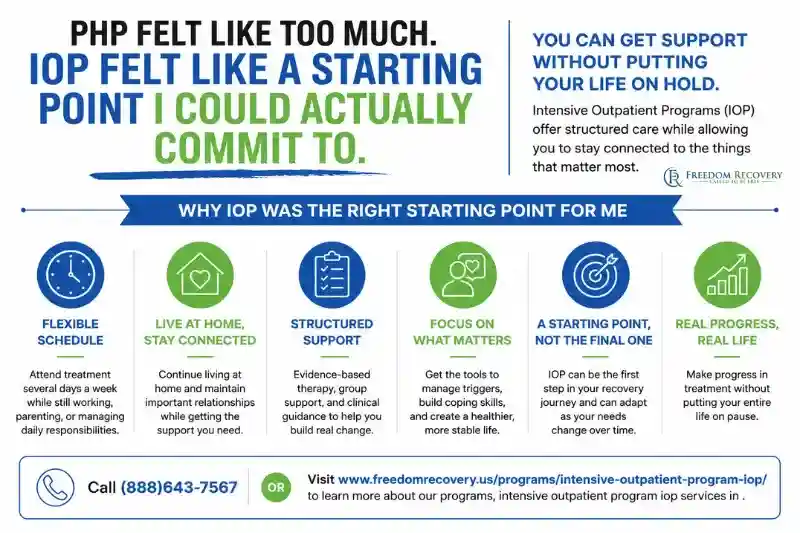
When I learned that multi-day weekly treatment could provide meaningful support while allowing me to stay connected to my daily responsibilities, something shifted.
For the first time, treatment felt less like hitting a giant red emergency button and more like taking a real first step.
Not a perfect step.
A real one.
The Fear of Being “Not Bad Enough”
This was the thought that kept me stuck longer than anything else.
“What if I take a spot from someone who needs it more?”
“What if people think I’m overreacting?”
“What if I’m not really struggling enough?”
The strange thing about high-functioning addiction is that success often becomes evidence against getting help.
You can point to your paycheck.
Your promotions.
Your responsibilities.
Your clean shirt.
Meanwhile, you’re quietly falling apart.
The question isn’t whether someone else has it worse.
The question is whether your current life is working.
Mine wasn’t.
Recovery Didn’t Start With Confidence
I wish I could tell you I walked into treatment feeling brave.
I didn’t.
I walked in feeling tired.
There is a difference.
Confidence says, “I’ve got this.”
Exhaustion says, “I can’t keep doing this.”
For me, exhaustion ended up being enough.
I didn’t need certainty. I didn’t need a dramatic turning point. I just needed a starting place that felt achievable.
That’s what made the difference.
Finding Support Without Disappearing From Your Life
One thing I appreciate now is that treatment isn’t always an all-or-nothing decision.
Different people need different levels of care at different times.
Some people benefit from highly structured daytime programming. Others need a level of support that allows them to continue working, parenting, or managing other responsibilities while still focusing on recovery.
If you’re trying to figure out where you fit, it can help to explore different forms of care in Addiction or learn more about available treatment options in Addiction.
The right starting point isn’t the one that sounds toughest.
It’s the one you’re actually willing to begin.
Sometimes the Best First Step Is the One You’ll Take
For a long time, I thought treatment had to completely upend my life before it could help me.
That belief kept me stuck.
What I eventually learned is that starting matters more than choosing the “perfect” path.
If you’ve been carrying everything on your shoulders while quietly wondering how much longer you can keep doing it, you’re not weak. You’re probably tired.
And tired people deserve support too.
Call (888)643-7567 or visit our intensive outpatient program iop services to learn more about our programs, intensive outpatient program iop services in .